
Intro post:
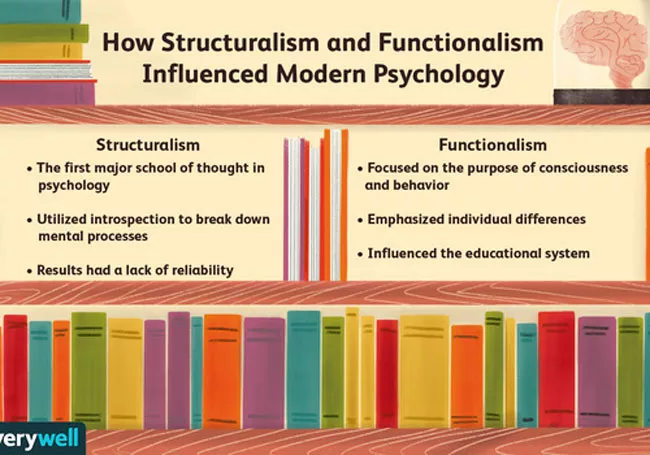
Psychology did not always exist as we know it today. In its early days, psychologists tried to understand the human mind using two major approaches: structuralism and functionalism. These schools of thought laid the foundation for modern psychology by exploring how the mind works and why it works that way.
Although these theories developed in the late 19th century, their influence continues to shape research, therapy, and education today.
What Is Structuralism?
Structuralism was one of the first attempts to study psychology scientifically.
It focused on breaking down mental processes into their smallest components to understand the structure of the human mind.
Founder of Structuralism
Structuralism was founded by Wilhelm Wundt, often called the father of psychology.
His student Edward Titchener later expanded and popularized the theory.
Main Idea
Structuralists believed that:
The mind can be understood by analyzing basic elements like sensations, feelings, and perceptions.
They used a method called introspection, where individuals described their own thoughts and experiences in detail.
Example
If someone ate an apple, structuralists would ask them to describe:
- Taste
- Texture
- Color
- Emotional reaction
- Sensory experience
They wanted to break experience into pieces.
What Is Functionalism?
Functionalism developed as a reaction to structuralism. Instead of asking what the mind is made of, functionalists asked:
What is the purpose of the mind?
Founder of Functionalism
Functionalism was strongly influenced by William James, an American psychologist and philosopher.
Main Idea
Functionalists believed mental processes exist because they help people adapt, survive, and function in their environment.
Rather than analyzing tiny mental elements, they studied:
- Behavior
- Learning
- Emotions
- Adaptation
- Practical use of thinking
Key Differences Between Structuralism and Functionalism
| Feature | Structuralism | Functionalism |
|---|---|---|
| Focus | Structure of the mind | Function of the mind |
| Main Question | What are mental processes made of? | Why do mental processes exist? |
| Method | Introspection | Observation & real-world behavior |
| Founder | Wilhelm Wundt / Edward Titchener | William James |
| Approach | Analytical | Practical & adaptive |
| Legacy | Influenced experimental psychology | Influenced behaviorism & applied psychology |
Why Structuralism Declined
Structuralism eventually faded because:
- Introspection was too subjective.
- Results were difficult to verify scientifically.
- It ignored real-world behavior.
However, it helped establish psychology as a scientific discipline.
Why Functionalism Became Influential
Functionalism gained popularity because it focused on real-life applications.
It influenced several major areas:
- Behaviorism
- Educational psychology
- Evolutionary psychology
- Applied psychology
- Mental health practices
Functionalism made psychology more practical and useful.
How These Theories Shaped Modern Psychology
Today, psychologists don’t follow structuralism or functionalism alone, but both contributed essential ideas:
- Structuralism introduced scientific study of consciousness.
- Functionalism introduced understanding behavior in context.
Modern psychology combines biological, cognitive, and behavioral approaches — all influenced by these early schools.
Conclusion
Structuralism and functionalism were two pioneering approaches that helped psychology grow from philosophy into a scientific field. Structuralism tried to understand the building blocks of the mind, while functionalism focused on how mental processes help us live, adapt, and thrive.
Even though these theories are no longer dominant, they remain crucial to understanding how psychology evolved into the discipline we know today.


