
Intro post:
Have you ever noticed how people repeat actions that bring them rewards and avoid actions that lead to negative outcomes? This everyday learning process is known as operant conditioning. It is one of the most important concepts in psychology and explains how habits are formed, how children learn, and even how workplaces motivate employees.
Operant conditioning focuses on how behavior is influenced by its consequences. Simply put, we learn from what happens after we do something.
What Is Operant Conditioning?
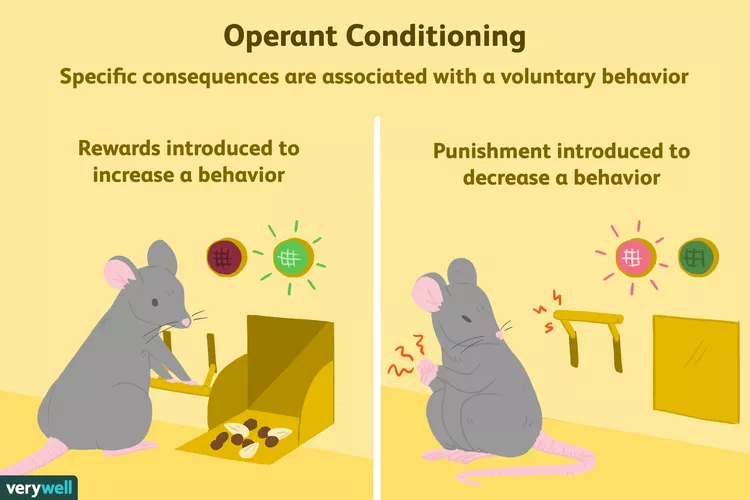
Operant conditioning is a learning method in which behavior is strengthened or weakened based on the results that follow it. When an action leads to a positive outcome, we are more likely to repeat it. When it leads to discomfort or loss, we tend to avoid it in the future.
This type of learning happens continuously in daily life — at home, in school, at work, and even while using social media.
How Operant Conditioning Works
The process follows a simple pattern:
Behavior → Consequence → Future Behavior
If the consequence is rewarding, the behavior becomes stronger.
If the consequence is unpleasant, the behavior becomes weaker.
For example, when a student studies hard and receives good grades, they feel motivated to continue studying. The positive result reinforces the behavior.
Key Elements of Operant Conditioning
1. Reinforcement (Encouraging Behavior)
Reinforcement is anything that increases the likelihood of a behavior happening again.
Positive Reinforcement
This involves adding something pleasant after a behavior.
Examples:
- Giving a child praise for completing homework
- Receiving a bonus for good job performance
- Getting likes on a social media post
These rewards encourage repetition of the action.
Negative Reinforcement
This involves removing something unpleasant to encourage behavior.
Examples:
- Turning off a loud alarm when you wake up
- Completing a task to avoid stress or reminders
Negative reinforcement is not punishment — it actually strengthens behavior.
2. Punishment (Reducing Behavior)
Punishment is used to decrease unwanted behavior.
Positive Punishment
Adding an unpleasant consequence.
Examples:
- Getting scolded for being late
- Paying a fine for breaking rules
Negative Punishment
Taking away something enjoyable.
Examples:
- Losing phone privileges
- Canceling a reward due to poor behavior
Punishment discourages repeating the action.
Why Timing Matters in Learning
The effectiveness of operant conditioning depends heavily on when consequences occur.
- Immediate feedback leads to faster learning.
- Delayed consequences are less effective.
- Consistent reinforcement builds strong habits.
- Occasional rewards can make behaviors last longer.
This is why quick praise, instant feedback, or timely correction works best in shaping behavior.
Real-Life Examples of Operant Conditioning
Operant conditioning is not limited to psychology labs — it is everywhere:
In Parenting
Parents reward good manners to encourage children to behave well.
In Education
Teachers use grades, praise, and recognition to motivate students.
In the Workplace
Employers offer promotions, bonuses, or recognition to improve performance.
In Personal Habits
People exercise regularly because it leads to better health and confidence.
In Technology
Apps use notifications, badges, and rewards to keep users engaged.
Operant Conditioning vs. Reflex Behavior
It is important to distinguish between learned behavior and automatic reactions.
- Reflex behaviors happen naturally (like pulling your hand away from heat).
- Operant behaviors are learned and shaped by consequences.
Operant conditioning deals with choices we learn to make over time.
Why Operant Conditioning Matters Today
Understanding operant conditioning can help individuals:
- Build productive habits
- Improve parenting strategies
- Create effective teaching methods
- Increase workplace motivation
- Break negative behavior patterns
By recognizing how consequences shape actions, we can design environments that encourage positive growth and long-term success.
Conclusion
Operant conditioning explains one of the most powerful forces behind human behavior: we are shaped by what happens after we act. Rewards encourage repetition, while negative outcomes reduce unwanted behavior.
Whether raising children, managing teams, or improving personal habits, understanding this principle allows us to influence behavior in meaningful and lasting ways.
Meta Description (SEO):
Learn how operant conditioning works, including reinforcement, punishment, and real-life examples. Discover how consequences shape behavior and habits.
Suggested Keywords:
operant conditioning, behavior learning theory, reinforcement psychology, punishment vs reinforcement, habit formation psychology


